There are three ways to pay back a mortgage in the UK: repayment, interest only, and a mix of the two known as part and part. Which one you pick shapes your monthly payments, the total cost of the loan and what you still owe at the end of the term. This guide walks through each method in plain English, shows how the balance behaves over time, and explains which type of buyer each one tends to suit.
I have written it the way I would explain it across the desk. If you want to check the numbers for your own situation, our mortgage repayment calculator will show you the monthly figure for any loan amount, interest rate and term.
Every mortgage is made up of two parts: the capital (the amount you borrow) and the interest the lender charges on it, shown as a percentage rate. The repayment method decides how much of each you pay every month.
A repayment mortgage, sometimes called a capital and interest mortgage, is the one most people in the UK have. Each monthly payment covers that month's interest plus a slice of the capital. Provided you make every payment, the loan is cleared in full by the end of the mortgage term and you own your home outright.
In the early years most of your payment goes on interest, because the balance is at its biggest. As the balance comes down, the interest charged comes down with it, so a growing share of each payment chips away at the capital. That is why the debt falls slowly at first and then much faster towards the end.
The monthly cost is higher than interest only, but the total you pay over the term is lower because you are shrinking the amount interest is charged on every single month.
With an interest only mortgage you pay just the interest each month and none of the capital. Your monthly payment is lower, but the full loan amount is still owed at the end of the term. You need a separate repayment plan (savings, investments, a pension lump sum or the sale of a property) to clear it.
The total cost is higher than a repayment mortgage because interest is charged on the whole loan for the whole term. And the risk sits with you: if your plan falls short, you will have to find the difference, sell the property, or remortgage if a lender will allow it. If the balance cannot be repaid, the lender can demand the money and your home may be repossessed.
Lenders are far stricter about interest only than they were before 2008. On residential mortgages, most want a lower loan to value (often 75% or less), a credible and evidenced repayment plan, and in some cases a minimum income. Interest only is much more common, and much easier to arrange, on buy to let mortgages.
A part and part mortgage splits the loan: one portion is on repayment and the rest is interest only. Your monthly payment sits between the two, some of the capital is paid off as you go, and at the end of the term you owe the interest only portion rather than the full amount.
It can suit borrowers who expect a lump sum later (an inheritance, a pension, a bonus) but want to make real progress on the debt in the meantime. Not every lender offers it, and the interest only part usually has to meet the lender's normal interest only criteria.
The two charts below use the same example: a £200,000 mortgage over 25 years at a 5% interest rate. The figures are for illustration only and are not a quote or advice.
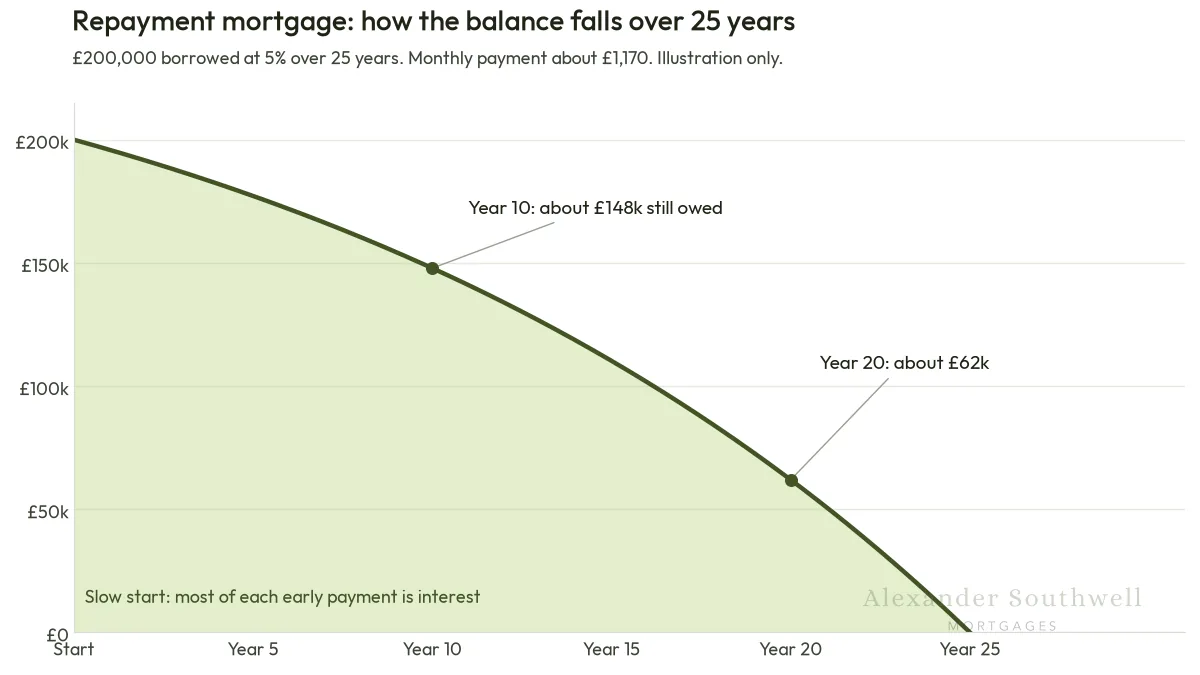
On the repayment mortgage the balance barely moves in the first few years. After 10 years you would still owe around £148,000. The curve then steepens, and the last £50,000 disappears in roughly the final five years.
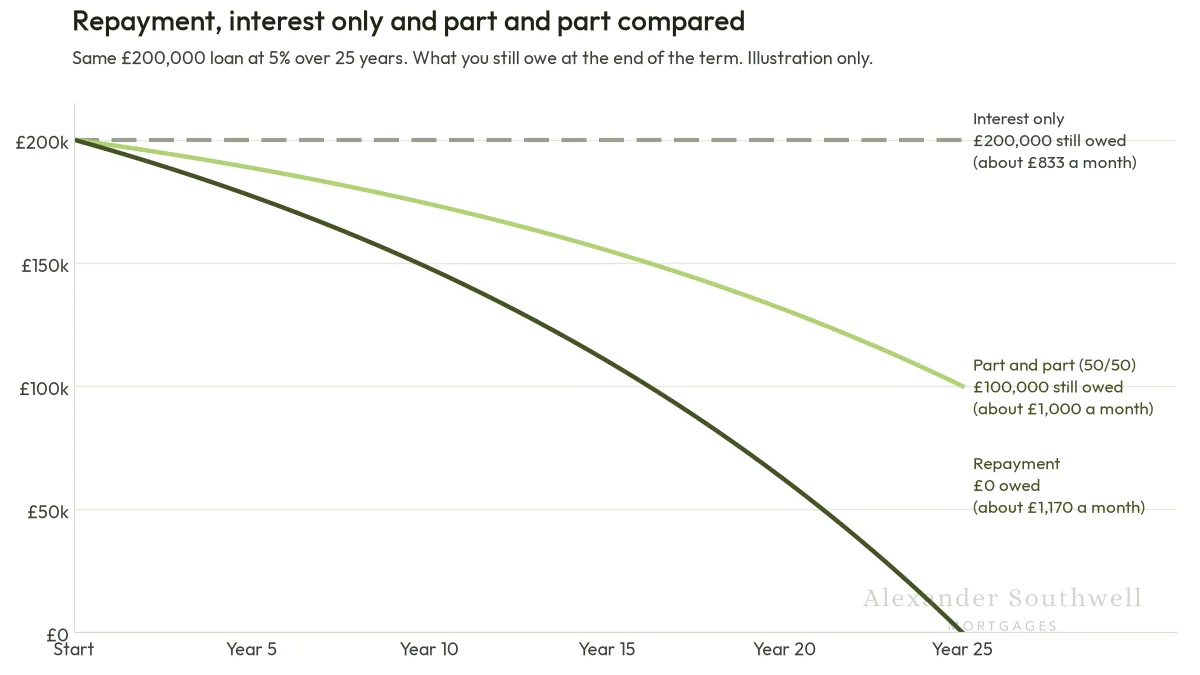
On interest only the line is flat. You pay around £833 a month (compared with about £1,170 on repayment) but you still owe the full £200,000 in year 25. The part and part example, split 50/50, lands in the middle on both the monthly payment and the closing balance.
For almost every first time buyer and home mover, a repayment mortgage is the sensible choice and in practice the only one most lenders will offer on a residential purchase. You build equity from month one, and if property values dip you have a growing cushion between what you owe and what the home is worth.
Landlords often prefer interest only. The lower monthly payment improves rental cover, and many plan to repay the loan by selling the property at the end of the term. That works while the property value holds up, but it is a plan built on the market, so it is worth stress testing it with an adviser.
Residential interest only still has a place for people with strong equity, a large deposit and a plan the lender will accept, such as a pension pot, investments already in place, or a second property. Expect the lender to ask for evidence, not just an intention.
The repayment method is one half of the picture. The interest rate on your mortgage deal is the other, and it works alongside whichever method you choose.
Your rate and payment stay the same for the deal period, typically two or five years. Good for budgeting, less flexible if rates fall. Our guide on two versus five year fixes goes into the trade offs.
Tracker mortgages follow the Bank of England base rate plus a set margin. When the base rate moves, your payment moves with it, up or down, usually from the following month. They tend to have lower early repayment charges, which makes them useful if you might overpay, sell or remortgage early. We compare the two in fixed vs tracker mortgages.
When a deal ends you usually roll onto the lender's SVR, which is set by the lender and is normally well above the rates on new deals. Sitting on the SVR is one of the most common and most expensive mistakes we see, and it is easily avoided by arranging a remortgage or product transfer a few months before the deal ends.
Yes, in many cases. Moving from interest only to repayment is usually straightforward as it reduces the lender's risk, though your monthly payment will rise. Going the other way is harder and means passing the lender's interest only criteria at that point. You can also shorten or extend the mortgage term, or make overpayments (most lenders allow 10% of the balance a year without an early repayment charge). Our guide to overpaying on your mortgage shows how much interest a modest overpayment can save.
Some do, with conditions. On residential property expect a maximum loan to value of around 75%, a repayment plan the lender can verify, and sometimes a minimum income. Buy to let interest only is widely available.
Usually, yes. Because the capital is not being repaid, lenders limit how much of the property value they will lend against, which means putting in more equity up front.
Typically existing savings or investments, an endowment policy, a pension lump sum, or the sale of another property. Selling the mortgaged home itself is accepted by some lenders but only where there is substantial equity. Lenders will ask you to evidence the plan and may check it during the term.
Repayment, almost always. In the £200,000 example above, interest only costs roughly £100,000 more in interest over 25 years (about £250,000 against £150,000), and you still owe the capital at the end.
Yes. Plenty of landlords choose repayment so the property is owned outright by retirement. The trade off is a higher monthly payment and tighter rental cover.
If you are weighing up repayment against interest only, or wondering whether part and part could work for you, talk it through with us before you apply. We are a fee free mortgage broker, we compare lenders across the whole market, and we will tell you plainly which repayment method and which type of deal fits your plans. You can also read our guide to the different types of mortgage before you call.
Get in touch or call us on 03300 432 428.
Your home may be repossessed if you do not keep up repayments on your mortgage. Figures in this guide are for illustration only and are not financial advice.