
Pop in a loan amount, an interest rate and a term. You will see your monthly repayments straight away, what the same loan costs on interest only, and what happens to your payments if the rate goes up by 1%. It's the sum most people want first, so I've put it at the top.
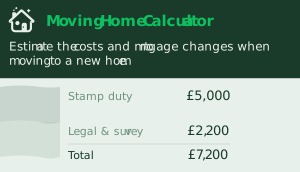
Adds up what moving really costs, from selling fees and any early repayment charge to the deposit left for your next place. Use it before you put your home on the market.
Plan Your MoveShows the rent, mortgage payment and total monthly cost for the share you buy, and what staircasing later could look like. Use it when you are weighing up a shared ownership home.
Check Affordability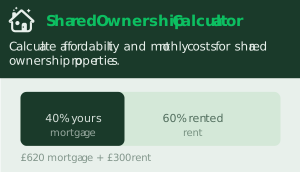
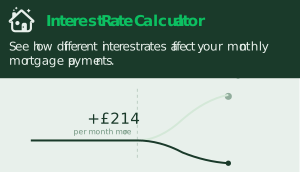
Compares rates and fees side by side, so you see the true monthly and overall cost of each deal. Use it when your fixed rate is ending or you have two offers to choose between.
Compare RatesWorks out your loan to value and the deposit needed for each LTV band. Use it to see whether a slightly bigger deposit could move you into a cheaper rate bracket.
Calculate LTV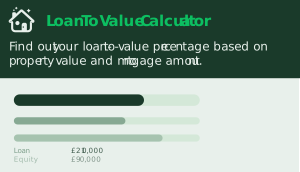
Gives you an idea of how much you could borrow based on your income, bonus and monthly commitments. Use it first, before you start booking viewings.
Estimate BorrowingShows how much interest and time you could save by making overpayments, monthly or as a lump sum. Use it when you have spare cash and want to clear your mortgage early.
Calculate Savings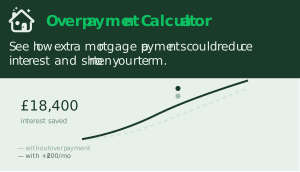
Works out how much stamp duty you could pay on a purchase, with separate figures for first time buyers, home movers and additional properties. Use it as soon as you have a price in mind.
Calculate Stamp DutyShows your monthly repayments and the total cost of the loan over the full term. Use it once you know roughly what you want to borrow and want to test different rates and terms.
Calculate Repayments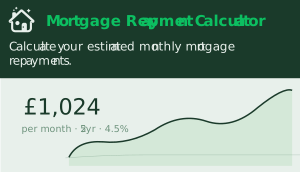
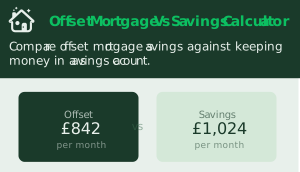
Compares putting your savings into an offset mortgage against leaving them in a savings account. Use it if you hold a decent pot of savings and want to know which works harder for you.
Compare OptionsMost people only need two or three of these. Here is where I'd point you, depending on where you are in your mortgage journey.

Start with the borrowing calculator to find out how much you could borrow, then the loan to value calculator to see what your deposit gets you. Run the stamp duty calculator on any place you like the look of, because first time buyer relief has a price limit. Looking at shared ownership? The shared ownership calculator shows the rent on the part you don't own. Our first time buyer mortgages guide covers the rest.
The moving home calculator is the one to use first. It works out what is left after you sell, clear your mortgage and pay the fees, which is your real deposit. Then check the stamp duty on the new place and run the borrowing calculator again, because your income has probably changed since you last applied. More on porting your deal in our moving home mortgages guide.
Use the interest rate calculator as your remortgage calculator. Compare a new deal with what you pay now, fees included. A rate that looks cheaper can cost more once a big arrangement fee is added on. If you are an existing customer, your lender will usually offer a product switch, so put that in as one of the options. Our remortgage page explains when moving lender is worth it.
The overpayment calculator shows what making overpayments does to your term and your overall interest. Many lenders let you overpay up to 10% of the balance each year without a charge while you are on a fixed rate, but check your own terms first. If you would rather keep the cash within reach, try the offset mortgage calculator.
These calculators are built for homes you live in. On an investment property the lender looks mainly at the rent, not just your income, and stamp duty includes the higher rate for additional homes. Use the stamp duty calculator for the tax, then speak to us about buy to let mortgages, because rental stress tests vary a lot from one lender to the next.
Repayment mortgages run on one standard formula, and lenders use a version of the same thing. Monthly payment M = P × r × (1 + r)^n ÷ ((1 + r)^n - 1). P is the loan, r is the yearly interest rate divided by 12, and n is the number of monthly payments. In plain English, each month you pay the interest on what you still owe, plus a slice of the loan itself. Early on most of the payment is interest. Later it flips the other way.
Take £200,000 over 25 years at 4.5%. That makes r 0.045 ÷ 12, which is 0.00375, and n is 300. Your monthly repayments come out at about £1,111.66, and you'd pay back around £333,500 in total, so roughly £133,500 is interest. On interest only the same loan is £750 a month, but you still owe the full £200,000 at the end.
Push that rate up to 5.5% and the payment goes to about £1,228.17. That's an extra £116 or so every month from a 1% rate change. Lenders know rates move, which is why they test your affordability at a higher rate than the one you are offered. A longer term brings the payment down, but your overall interest goes up.
I'm a fan of online mortgage calculators, which is why we built these. But a calculator only knows what you type in. A lender knows a lot more, and this is the bit that trips people up.
No calculator looks at your credit score. Lenders do. Most run a soft credit check at the agreement in principle stage, which other lenders can't see, then a full credit check when you make your mortgage application. A missed phone bill from two years ago could affect which lenders will look at you, so check your file early with our Checkmyfile guide.
Lenders treat income differently. One might count all of your bonus, another half, another none. Self employed income, overtime, maternity leave and childcare costs all get handled their own way. That's why two lenders can give the same couple figures tens of thousands of pounds apart.
Our borrowing calculator shows figures up to 6 times income, because a small number of lenders go that high for some professions and higher earners. Most lenders lend around 4 to 4.5 times income, so treat the top end as a best case, not a promise.
We don't put live mortgage rates into these tools because they change from week to week. Use a rate you have seen quoted, then speak to us for today's mortgage rates. When you compare a new deal, always add the fees in. Your repayments could look lower while the deal costs more overall.
A calculator gives you an idea of how much. An adviser tells you which lender is likely to say yes, at what rate, and what could get in the way. We are fee free on over 90% of the mortgages we arrange, so getting a proper answer usually costs you nothing. Get in touch or call 03300 432 428 for mortgage help from someone who will look at your whole picture.
The questions people ask us most after they have had a go with the calculators.
The maths is accurate. The inputs are the weak point. If the rate, term and loan you enter are right, the monthly repayments figure will be very close to what a lender quotes. What a calculator can't do is tell you whether a lender will accept your application.
No. Our calculators don't ask for your name, don't run any credit check and don't store what you type. Your credit file is only searched when a lender runs a check, usually at the agreement in principle or full application stage.
Most lenders lend around 4 to 4.5 times income, so a £50,000 salary typically means somewhere between £200,000 and £225,000. Some lenders go to 5 or 5.5 times, and a few go higher for certain professions. Car finance, loans and childcare costs bring the figure down.
Start with the borrowing calculator, then the loan to value calculator to see what your deposit gets you, then the stamp duty calculator. Those three answer the big questions for a first home: how much you can borrow, how much deposit you need and how much tax you pay.
On a repayment mortgage each payment clears some interest and some of the loan, so the balance reaches zero at the end of the term. On interest only you just pay the interest. Payments are lower, but you still owe the whole loan at the end and need a plan to pay it off.
On a £200,000 repayment mortgage over 25 years, each 1% rise adds roughly £110 to £120 a month for rates between 3.5% and 5.5%. The quick calculator at the top of this page shows what a 1% rise would do to your own figures.
It depends on your mortgage rate, your savings rate and whether you might need the money. Overpaying saves you interest at your mortgage rate. Savings earn the savings rate, less any tax. Keep an emergency fund first, then use the overpayment and offset calculators to compare both.
Yes. They are built around UK lending, UK stamp duty and pounds sterling. If you live abroad or are paid in another currency, lenders apply different rules, so speak to us directly instead of relying on the numbers.
Ready to put the numbers into action?
Our calculators give you a useful starting point, but every situation is different. Speak to one of our fee-free advisers to get accurate figures tailored to you. We help clients across Southampton, Romsey and Hampshire with first-time buyer mortgages, remortgages, moving home mortgages and buy-to-let mortgages. You may also want to consider mortgage protection insurance to safeguard your home and finances. Check today's best mortgage rates to see what deals are currently available.